
Liberian leader Ellen Johnson Sirleaf was on Thursday conferred the coveted Indira Gandhi peace prize by President Pranab Mukherjee who said India will continue to support the African nation in its pursuit of stability and economic growth.

Ghose was head of Indian delegation to the conference on the CTBT in Geneva in 1996 and she is hailed for strongly outlining India's position in opposing the treaty.

The chapters were dropped by the Assam Higher Secondary Education Council (AHSEC) for the 2020-21 session, as part of the 30 per cent reduction of the syllabus, keeping in mind the loss of academic schedule that the students had to face because of the pandemic.

The announcement of date and venue comes a day after Putin's adviser Yuri Ushakov in Moscow said the two leaders will meet in a third country.

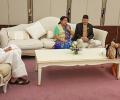
'Instead of writing NAM's obituary, India should reinvent it,' suggests Dr Rup Narayan Das.

India and the US signed a historic agreement to cooperate in civil nuclear energy sector in October 2008.
Noted social worker Ela Ramesh Bhatt was on Monday conferred the Indira Gandhi Prize for Peace, Disarmament and Development by President Pranab Mukherjee. Bhatt, the founder of Self-Employed Women's Association, was conferred the Indira Gandhi Prize for 2011 at a function in Rashtrapati Bhavan in the presence of Prime Minister Manmohan Singh and Congress president Sonia Gandhi.

The Narendra Modi government on Monday appointed Arvind Gupta, a former Indian Foreign Service officer, of the 1979 batch, as Deputy National Security Advisor. This appointment comes within days of Nehchal Sandhu quitting as deputy NSA, citing personal reasons.
Nuclear weapons have deterred world powers from issuing "explicit or implicit threats" to blackmail India to toe a particular line, National Security Advisor Shivshankar Menon said in New Delhi on Tuesday.
Democracy will remain central to India's national identity, but will not be a conscious axis of its foreign policy, reports Aziz Haniffa

India, the only country to send MPs to attend sessions of United Nations General Assembly, is deputing 13 Parliamentarians this time, including Bharatiya Janata Party leader L K Advani.

Aziz said Pakistan is committed not to transfer nuclear weapons to other states or assist others to acquire nuclear weapons and consistently supported the goal of a nuclear-weapons-free world.
Protesting against the NSG waiver to India, Pakistan today blocked negotiations on Fissile Material Cut-off Treaty (FMCT), describing the move as "discriminatory" that will help New Delhi stockpile bomb- making nuclear materials.
In an open letter to Team Anna, Colonel Anil Athale questions their obsession with the Lokpal Bill. Athale suggests the merger of existing anti-corruption wings of all departments and public enterprises with Lokpal instead of creating another huge army of clerks.
Pitching for "progressive steps" to de-legitimise nuclear weapons, Prime Minister Manmohan Singh on Wednesday said a meaningful dialogue was needed among countries having atomic weapons to build trust and reduce the dangers of their accidental or unauthorised use.
Had it not been for the global concern with respect to 'climate change', the nuclear states with a large stockpile of weapons would not have allowed other countries to adopt nuclear energy, said Dr Anil Kakodkar, member of the Atomic Energy Commission.
Chinese Vice-Foreign Minister Wu Dawei said the Chinese side believes it is necessary for the delegation of the six-party talks who had the important task of fully implementing the 2005 joint statement to bring about peace and stability in the Korean peninsula, to meet and exchange views to make due contribution in maintaining peace in the peninsula and easing tensions in Northeast Asia.
India has said it was "deeply worried" over the potential nexus between clandestine proliferation of nuclear weapons and terrorism and favoured "transparent verification procedures" to prevent such materials falling in dangerous hands.

This will be the fourth visit of Modi to China after he came to power in 2014.

Interview with strategic analyst C Raja Mohan on the recent Nuclear Summit in the US
A top British diplomat in September 2009 told a visiting American diplomat that China has "dumped" Pakistan in the Conference on Disarmament, according to a United States cable leaked by whistleblower site WikiLeaks on Wednesday.
'A lot of people in India are not ready to move on. You are still concerned that any defence deal with the US will constrain your strategic autonomy, as if the US had the power to do that,' says Michael Krepon, co-founder of the Henry L Stimson Centre, a Washington, DC think-tank.

North Korea had recently called on its citizens to be ready for a nation-wide struggle against 'war thirsty' Trump.
Australia, home to the world's largest uranium reserves, could drop its ban on selling the yellowcake to India after a panel commissioned by Prime Minister Kevin Rudd and his Japanese counterpart Yukio Hotoyama recommended changes to the nuclear non-proliferation regime.
The Nobel committee awarded the peace prize to Barack Obama for his "extraordinary efforts to strengthen international diplomacy and cooperation between peoples and cited his push for nuclear disarmament".

Bangladesh Prime Minister Sheikh Hasina has been chosen for the prestigious Indira Gandhi Prize for Peace, Disarmament and Development this year for her "outstanding contribution to the promotion of democracy and pluralism".
A landmark treaty banning cluster munitions will come into force from August 1, the United Nations announced, but all major powers, the US, China, Russia Israel and India are shunning it.
"This administration will work toward a world without nuclear weapons and we will continue to maintain a safe, secure, and effective deterrent as we proceed toward that goal," Ellen Tauscher, Under Secretary for Arms Control and International Security, said.

"Just a limited regional nuclear exchange, for example between India and Pakistan, with each side attacking the other's major cities with 50 low-yield Hiroshima-sized weapons, would throw up major concentrations of soot into the stratosphere, which would remain there for long enough to cause unprecedented climate cooling worldwide, with major disruptive effects on global agriculture," says a report jointly produced by Japan and Australia on nuclear non-proliferation.
The manner in which India and Pakistan have pursued atomic weapons has 'upset the balance of nuclear deterrence', United States Secretary of State Hillary Clinton said on Friday, asserting that the US is working hard with both countries to try to limit their number of nuclear stockpiles.
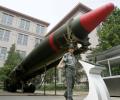
Despite four disarmament section talks and six strategic dialogues between the two foreign ministries, China's intransigence on recognising Indian nuclear status resulted in no confidence building measures in the nuclear field between the two, says Srikanth Kondapalli.

Mohammad ElBaradei, director general of International Atomic Energy Agency, was on Wednesday honoured with the prestigious Indira Gandhi Prize for Peace, Disarmament and Development for his 'impassioned opposition to use of nuclear energy for military purposes.'
India today welcomed the renewed global push for achieving a world free of atomic weapons but underlined that the international nuclear order cannot be "discriminatory".
The new UN Security Council resolution on nuclear non-proliferation and disarmament makes it difficult for the NPT signatory countries to withdraw from the regime and calls upon nations to enter into safeguard agreements with the International Atomic Energy Agency.
India will most likely sign the Comprehensive Test Ban Treaty--a top non-proliferation priority of the Obama Administration--if the world moves "categorically towards nuclear disarmament in a credible time-frame," India's point man for nuclear issues has indicated.
India and the United States on Monday agreed to move ahead towards a non-discriminatory, internationally and effectively verifiable Fissile Material Cut-off Treaty and pledged to cooperate to prevent nuclear terrorism.
After raising India's heckles by issuing visas in a separate sheet of paper to several residents of Jammu and Kashmir, China issued a visa stamped on passport to former Jammu University vice chancellor Amitabh Mattoo, a domicile of the state, who visited the neighbouring country. Mattoo, who had applied for a visa in the Chinese Embassy in New Delhi to attend an international conference on nuclear disarmament in China in November, had been given a regular stamped visa.
A Washington Post report, quoting both US officials and South Asian experts, says that the arms race between India and Pakistan 'has begun to take on the pace and diversity, although not the size, of US-Soviet nuclear competition during the Cold War.'

President Pratibha Patil on Saturday presented the Indira Gandhi Prize for Peace, Disarmament and Development to Microsoft founder Bill Gates for his charity work.
 © 2026 Rediff.com - Advertise with us - Disclaimer - Privacy Policy - Sitemap - Feedback - About us - Terms of use - Grievances